
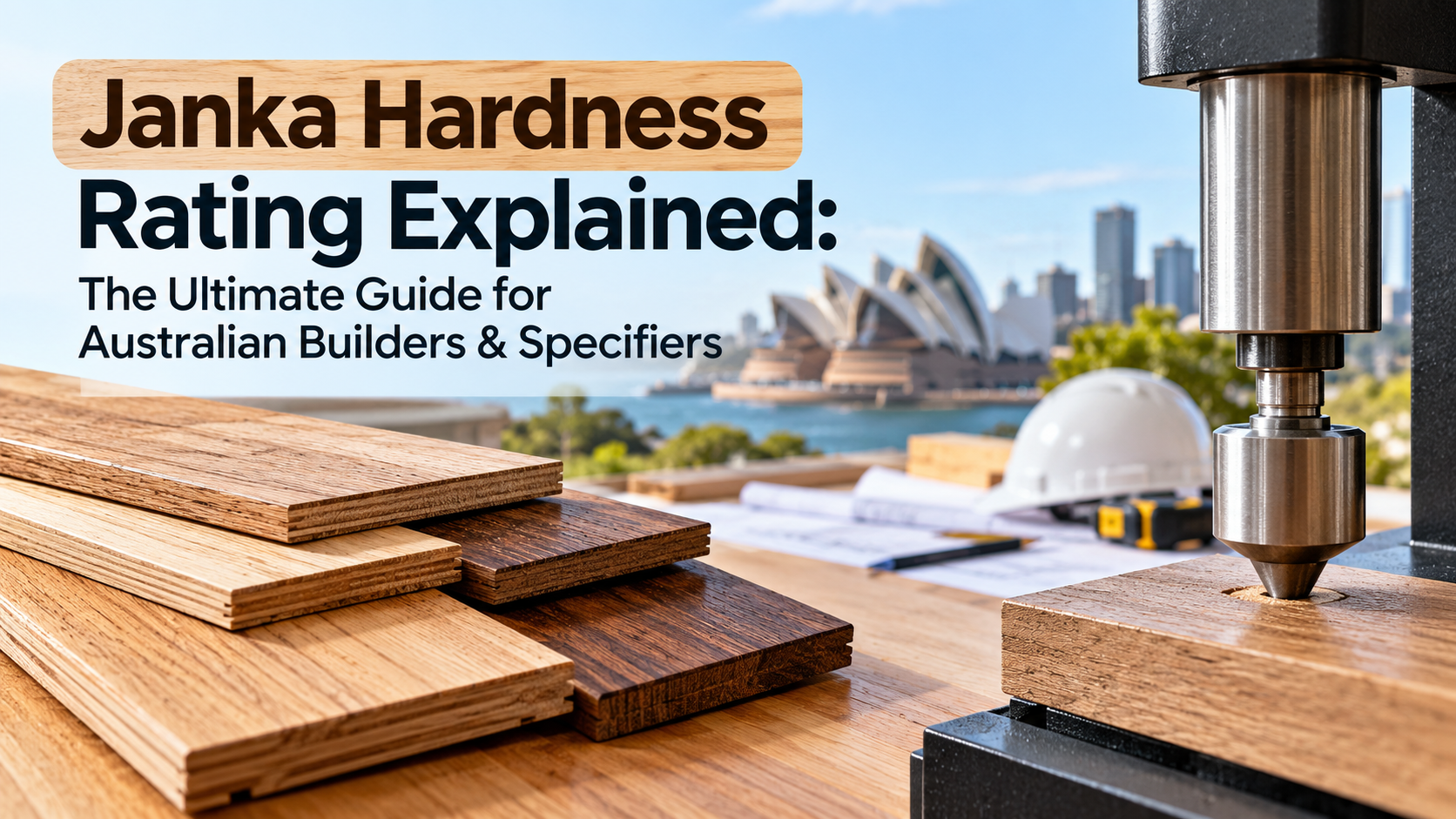
Selecting a species based only on colour and grain pattern is insufficient when choosing wood for heavy-duty structural applications, outdoor entertainment decks, or high-traffic indoor flooring. You must comprehend the physical density and indentation resistance of your wood surface in order to make sure it can sustain normal wear, impact from furniture, pet claws, and heavy foot traffic.
The Janka hardness rating is used to quantify this physical strength parameter in the building and lumber industries. Builders, architects, and homeowners may choose the best hardwood timber supplies for any business or residential project by understanding how Janka ratings operate, guaranteeing long-term durability and beauty.
What Is the Janka Hardness Rating?
The Janka hardness rating (or Janka scale) is an international standard test that measures the relative hardness and indentation resistance of different wood species. Developed by Austrian researcher Gabriel Janka in 1906 and standardized under ASTM D143, the test evaluates how resistant a timber sample is to denting, scratching, and mechanical wear.
How Is the Janka Test Conducted?
The test measures the amount of force required to embed an 11.28 millimeter (0.444 inch) steel ball halfway into a sample of wood. The depth is precisely measured until the diameter of the ball reaches its midpoint within the timber face.
- Measurement Units: Different units are used to express the test internationally. Janka ratings are expressed in kilonewtons (kN) or Newtons (N) in Australia and Europe. It is measured in pounds-force (lbf) in the US.
- Grain Direction: The force applied perpendicular to the wood grain (side hardness) is measured by the standard test. Although end grain (end hardness) testing usually produces better results, it is less indicative of how flooring and deck boards function in practical situations.
Why Janka Hardness Matters for Timber Selection
The longevity of your surface is directly impacted by the choice of wood with the appropriate Janka rating. The rating is an important specification factor for the following reasons:
- Indentation & Scratch Resistance: High-traffic environments—such as busy corridors, kitchens, and retail shopfronts—benefit from dense hardwood flooring that resists structural denting caused by stiletto heels, falling objects, and furniture legs.
- Workability on Site: While high Janka ratings mean maximum surface durability, extremely hard timber is harder to cut, nail, plane, and sand. It requires specialized carbide-tipped saw blades and pre-drilling for screws.
- Longevity & Refinishing Cycles: Extremely dense hardwoods can be sanded back and refinished multiple times over decades without losing structural thickness or integrity.
The Australian Timber Janka Hardness Scale
Australian eucalypts produce some of the dense and hardest commercial timbers in the world. To put ratings into perspective, softer pines sit near the bottom of the scale, while native Australian structural hardwood species dominate the top.
Low Density / Softwood Range (< 5.0 kN)
Timbers in this range are easy to cut, lightweight, and economical, but they indent very easily under direct point loads.
- Radiata Pine: ~3.3 kN
- Oregon / Douglas Fir: ~4.8 kN
- Western Red Cedar: ~1.5 kN
- Best Uses: Internal wall framing, roof trusses, moldings, and budget-friendly treated pine timber.
Moderate Density Range (5.0 kN – 8.5 kN)
These species provide a combination of workability and dent resistance, and are suitable for general residential joinery and low-impact flooring.
- Tasmanian Oak: ~5.5 kN
- American Oak: ~6.0 kN
- Jarrah: ~8.5 kN
- Best Uses: Furniture, interior cabinetry, stair components, architraves, and mid-traffic indoor flooring.
High Density / Dense Hardwood Range (8.5 kN – 11.0 kN)
Perfect for busy family homes, outdoor living areas and light commercial.
- Blackbutt: ~9.1 kN
- Silvertop Ash: ~9.5 kN
- Spotted Gum: ~11.0 kN
- Best Uses: High-traffic hardwood decking, commercial cladding, feature joinery, and durable interior floors.
Extreme Density Range (> 11.0 kN)
These species, which provide top-notch wear resistance and structural performance, are the mainstays of the Australian timber industry.
- Sydney Blue Gum: ~11.5 kN
- Grey Box: ~15.0 kN
- Red Ironbark & Grey Ironbark: ~14.0 kN – 15.0 kN
- Best Uses: Heavy industrial flooring, bridge construction, heavy-duty wharf posts, and high-impact commercial hardwood decking.
Janka Rating vs. Timber Durability Class: What’s the Difference?
A common point of confusion among specifiers is mixing up a species’ Janka hardness rating with its timber durability class:
- Janka Hardness (Physical Strength): Measures resistance to physical wear, scratches, impact dents, and mechanical abrasion.
- Timber Durability Class (Chemical & Fungal Resistance): Governed by AS 5604, this rates a species’ natural chemical ability to resist fungal decay, rot, and termite attack in outdoor or ground-contact environments.
Tasmanian oak has a lower natural outdoor decay resistance (Class 3/4) but a significant physical hardness (~5.5 kN). On the flip side, species such as Red Ironbark are naturally very durable (Class 1) and extremely hard (~14.0 kN), making them suitable for tough outdoor applications.
Selecting the Right Janka Rating for Common Applications
For more accurate timber building supplies for your project needs, some suggested Janka ranges are given here:
1. High-Traffic Residential & Commercial Flooring
Timber that can withstand indentation from dropped objects and shoes is necessary for busy family houses with pets, kids, or direct street entry.
- Recommended Janka Rating: 8.5 kN – 14.0 kN
- Top Species: Spotted Gum, Blackbutt, Ironbark.
2. Outdoor Hardwood Decking & Boardwalks
Exposed decks are subject to heavy foot traffic, continual weathering and thermal expansion.
- Recommended Janka Rating: 9.0 kN – 15.0 kN
- Top Species: Spotted Gum, Blackbutt, Merbau, Ironbark.
- Key Advantage: High density reduces surface splintering, checking, and cupping over time.
3. Bushfire-Prone Exterior Builds (BAL Ratings)
Dense hardwoods frequently serve as naturally fire-retardant materials if your construction site is located in a bushfire zone as defined by Australian Standard AS 3959.
- Top Species: Spotted Gum, Blackbutt, Red Ironbark, Silvertop Ash.
- Compliance: Meets BAL-29 timber building standards naturally without requiring chemical fire-retardant dips.
4. Custom Furniture & Internal Joinery
For furniture, workability, stainability and a fine grain finish are more important than extreme hardness.
- Recommended Janka Rating: 5.0 kN – 8.5 kN
- Top Species: Tasmanian Oak, Jarrah, American Oak.
Working with High Janka Rating Hardwoods
You need special on-the-job techniques to work with Australia’s ultra-dense hardwood timbers:
- Pre-Drilling: Always pre-drill pilot holes near board ends to avoid splitting dense fibers when fastening screws or driving nails.
- Quality Tooling: Use sharp, carbide-tipped saw blades and router bits. High-density wood generates heat faster, which can dull standard steel blades quickly.
- Proper Acclimatization: Allow interior flooring boards to adjust to the local site environment and humidity levels prior to installation to ensure dimensional stability.
- Regular Sealing: Protect high-density timber with a quality oil or sealant immediately after installation to lock in moisture content and prevent surface checking under harsh UV exposure.
What is a good Janka hardness rating for residential flooring?
For residential flooring, a Janka rating between 8.0 kN and 11.0 kN is ideal. Native species like Blackbutt (~9.1 kN) and Spotted Gum (~11.0 kN) provide superior indentation resistance against daily foot traffic, pet claws, and heavy furniture without being overly difficult to sand or install.
Does a higher Janka rating mean the timber is completely scratch-proof?
There is no wood that is completely impervious to scratches. The protective surface coating (such as polyurethane, lacquer, or oil) might still scratch even when a high Janka rating guards against deep impact dents. The finish can be preserved by routinely washing and placing felt pads beneath furniture legs.
Which Australian hardwood species has the highest Janka hardness rating?
Grey Box (~15.0 kN), Grey Ironbark (~14.0 kN), and Red Ironbark (~14.0 kN) are among Australia’s hardest commercial timbers, and among the hardest worldwide. They offer exceptional density and structural resistance.
Is Radiata Pine suitable for outdoor decking based on its Janka rating?
Radiata Pine has a low Janka rating (~3.3 kN), meaning it indents easily under foot traffic and heavy patio furniture. While it can be used for outdoor decking when treated with an H3 timber treatment, dense Australian hardwoods like Spotted Gum or Blackbutt offer significantly longer lifespans and better scratch resistance.
How does the Janka rating affect sanding and refinishing?
Denser wood with a higher Janka rating necessitates the use of specialised abrasive materials and heavier sanding equipment during installation or restoration. High-Janka hardwood floors, however, can be repeatedly sanded back and refinished over many decades without sacrificing structural integrity because to their high density.
