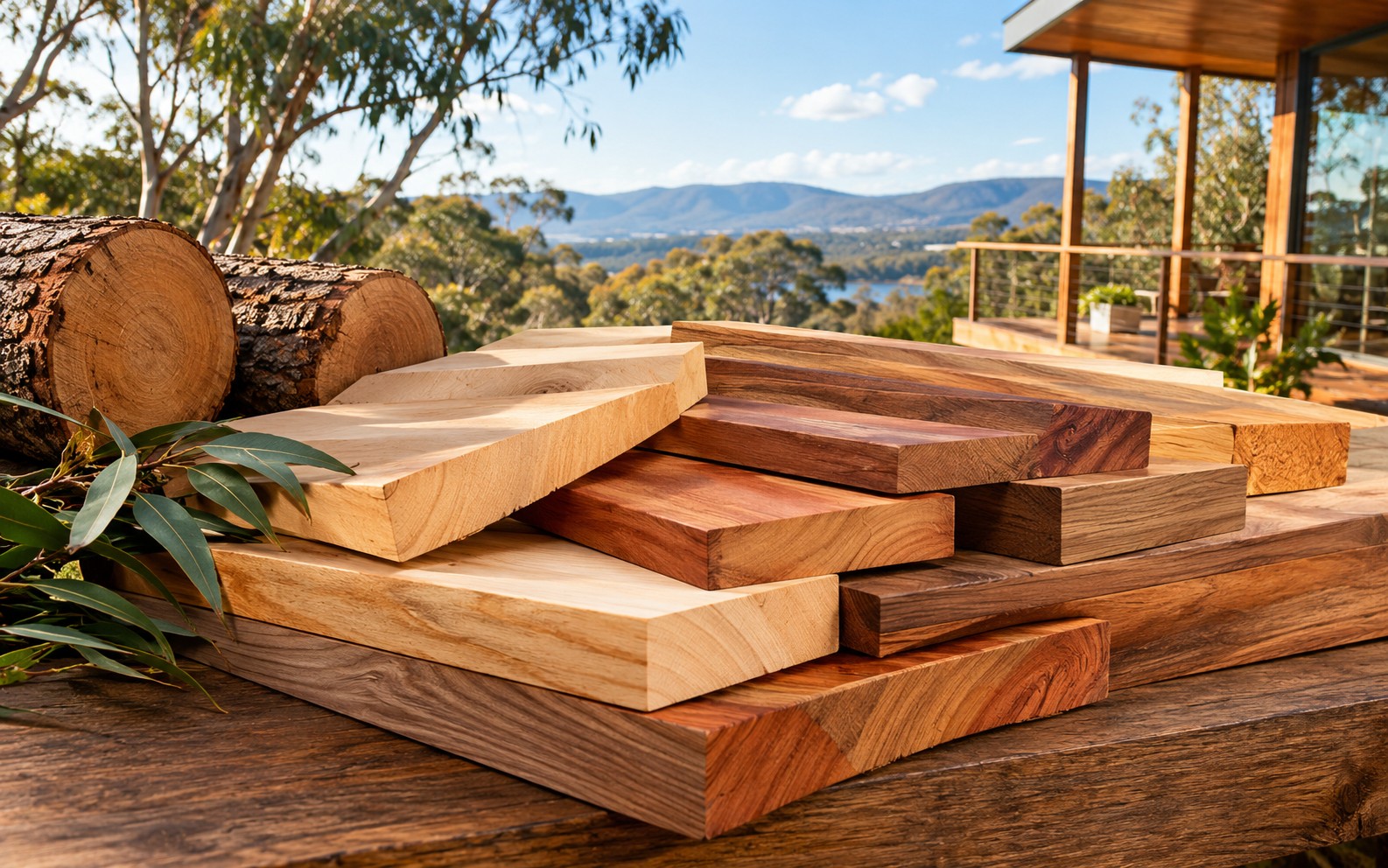
Australia has some of the most robust, structurally solid and well-looking timber species in the world. Responsibly sourced indigenous eucalypts and softwoods provide building materials that can withstand intense UV, weather conditions and high loads.
Choosing the proper species of wood is one of the most important decisions in any building, renovation or landscaping project. Whether you’re specifying heavy-duty structural hardwood for house framing, premium hardwood decking for outdoor entertaining areas or elegant interior hardwood flooring, this comprehensive guide covers the properties, durability ratings and ideal applications of top Australian timber species.
Understanding Timber Performance: Durability Classes & BAL Ratings
Before you pick a timber species for your project, it’s important to understand how Australian standards assess timber strength and natural durability.
Durability Classes
Australian timbers are classified into four durability categories based on their natural resistance to decay and insect attack when exposed to ground contact:
- Class 1 (In-Ground Life > 25 Years): Superior natural durability. Excellent performance in exposed outdoor conditions (e.g. Ironbark, Spotted Gum).
- Class 2 (In-Ground Life 15–25 Years): High natural durability. Suitable for outdoor above-ground and in-ground applications (e.g., Blackbutt, Jarrah).
- Class 3 (In-Ground Life 8–15 Years): Moderate durability. Best suited for protected or above-ground applications unless pressure treated.
- Class 4 (In-Ground Life < 8 Years): Low natural durability. Suitable for internal framing or joinery.
Bushfire Attack Level (BAL) Compliance
Due to Australian building regulations under AS 3959, properties located in designated bushfire zones require naturally fire-resistant timber. Seven primary Australian hardwoods are designated as naturally fire-retardant and meet BAL-29 timber construction standards without requiring external chemical fire treatments.
Premium Native Australian Hardwood Species
Native Australian hardwood species are well known around the world for their high Janka hardness ratings, deep cellular structure, and exceptional density. The most commonly listed native hardwoods in Australia are as follows:
1. Spotted Gum (Corymbia maculata)
Spotted Gum is undoubtedly one of Australia’s most popular commercial hardwoods. Native to the eastern coast, it comes in rich colour ranges from soft light brown to deep chocolate brown, often with a distinctive wavy fiddleback grain.
- Durability: Class 1 above ground / Class 2 in-ground
- Janka Hardness: ~11.0 kN
- Fire Rating: BAL-29 approved
- Best Uses: High-traffic hardwood decking, architectural cladding, structural posts, and luxury internal flooring.
2. Blackbutt (Eucalyptus pilularis)
Warm golden-brown colours and a straight grain pattern make blackbutt a highly sought-after hardwood. Its modern, clean design blends in perfectly with minimalist architecture.
- Durability: Class 1 above ground / Class 2 in-ground
- Janka Hardness: ~9.1 kN
- Fire Rating: BAL-29 approved
- Best Uses: Interior flooring, external cladding, posts, joists, and general structural hardwood applications.
3. Red & Grey Ironbark (Eucalyptus crebra / sideroxylon)
Ironbark is the ultimate in strength and structural dependability. Ironbark wood has rich crimson, dark red, and deep brown tones and is incredibly solid and hefty.
- Durability: Class 1 both in-ground and above ground
- Janka Hardness: ~14.0 kN
- Fire Rating: BAL-29 approved
- Best Uses: Heavy civil engineering, bridge construction, heavy-duty posts, high-impact commercial floors, and premium decking.
4. Jarrah (Eucalyptus marginata)
Jarrah, which comes from Western Australia, is renowned for its deep burgundy to rich dark crimson hues that age beautifully. Termites and marine borers are repelled by its remarkable natural extractives.
- Durability: Class 2 in-ground and above ground
- Janka Hardness: ~8.5 kN
- Best Uses: High-end outdoor decking, feature furniture, custom joinery, and decorative timber linings.
5. Silvertop Ash (Eucalyptus sieberi)
Grown predominantly in southeastern Australia, Silvertop Ash presents warm silvery-brown tones with natural dark gum veins and growth rings that give it a rustic, organic character.
- Durability: Class 2 above ground
- Janka Hardness: ~9.5 kN
- Fire Rating: BAL-29 approved
- Best Uses: External wall cladding, decking, screening, and general framing timber.
6. Tasmanian Oak (Combination of E. regnans, E. obliqua, E. delegatensis)
Tasmanian Oak is a hardwood blend ranging from straw yellow to light reddish-pink. It is widely praised by woodworkers for its excellent machining, staining, and finishing properties.
- Durability: Class 3 above ground
- Janka Hardness: ~5.5 kN
- Best Uses: Internal joinery, stairs, cabinetry, architraves, lining boards, and indoor flooring.
Sustainable Australian Softwood Species
Sustainably farmed softwoods serve as the structural foundation for affordable outdoor building materials and home frame, while hardwoods excel in density and weather resilience.
Radiata Pine (Pinus radiata)
Australia’s main commercial plantation softwood is radiata pine. It grows quickly, is lightweight, straight-grained, and has a remarkable ability to absorb chemical preservatives.
- Treatment Levels: Commonly available in H2 (internal termite protection), H3 timber treatment (above-ground outdoor use), and H4 (in-ground ground contact).
- Best Uses: Wall framing, roof trusses, sub-floor joists, pergolas, retaining walls, and cost-effective pine fencing.
Cypress Pine (Callitris glaucophylla)
Unlike plantation pine, native Cypress Pine is a unique softwood featuring high natural resin content that gives it natural termite and decay resistance without requiring chemical treatments.
- Durability: Class 1 in-ground / Class 2 above ground
- Best Uses: House stumps, fence posts, deck substructures, and exposed feature posts.
Uses of Australian Timber Species in Construction
Matching the correct timber species to your specific building application ensures maximum structural longevity and minimal maintenance issues.
1. Outdoor Hardwood Decking & Boardwalks
Outdoor decks that are exposed need very dense wood that doesn’t shrink much, so as to avoid cupping, checking and warping.
- Top Species: Spotted Gum, Blackbutt, Ironbark, Merbau.
- Why: High natural resistance to moisture decay, scratching, and intense sunlight.
2. Residential Framing & Structural Engineering
To securely support large structural loads, approved stress-graded materials are needed for wall frames, roof trusses, floor bearers, and joists.
- Top Species: Radiata Pine (MGP10/MGP12), F17 Hardwood (Ironbark/Spotted Gum).
- Why: Softwood pine offers lightweight efficiency for framing, while structural hardwood provides high bending strength for heavy beams.
3. Interior Flooring & Architectural Joinery
The distinguishing features of wood for indoor flooring and custom joinery are impact indentation and the beauty of natural grain.
- Top Species: Spotted Gum, Blackbutt, Tasmanian Oak, Jarrah.
- Why: High Janka hardness preserves floor surfaces against pet claws, heels, and furniture wear.
4. Exterior Cladding & Screening
Facade cladding requires dimensionally stable timber species that perform reliably when exposed to wet-dry cycles and high fire risk zones.
- Top Species: Silvertop Ash, Blackbutt, Spotted Gum.
- Why: Certified BAL-29 ratings and excellent dimensional stability under external coatings.
Timber Maintenance Best Practices
To preserve the strength, structural integrity, and natural color of native Australian timber:
- Pre-Sealing: Coat all timber surfaces—including end grains and underside cuts—with a high-quality oil or primer before installation to mitigate moisture absorption.
- Scheduled Re-Oiling: Re-apply protective oil to external hardwood decking and cladding every 12 to 18 months to protect against UV bleaching and fine surface checking.
- Sub-Floor Ventilation: Make sure the deck sub-floors are well ventilated so that moisture doesn’t accumulate under the floorboards.
What is the most durable Australian timber species for outdoor use?
Grey Ironbark and Red Ironbark are widely considered the most durable native timber species. Holding a Class 1 durability rating for both in-ground and above-ground use, alongside a high Janka hardness rating of ~14.0 kN, Ironbark resists rot, termites, and mechanical wear better than almost any other timber.
Which Australian timber species are approved for BAL-29 bushfire zones?
Seven Australian hardwood species are naturally fire-retardant and BAL-29 approved under AS 3959: Spotted Gum, Blackbutt, Red Ironbark, Silvertop Ash, Turpentine, River Red Gum, and Yellow Stringybark.
What is the difference between MGP10 Radiata Pine and F17 Hardwood?
MGP10 (Machine Graded Pine) is a softwood framing material optimised for cost-effective, lightweight residential wall studs and roof trusses. F17 Hardwood is a stress-graded structural hardwood designed for heavy load-bearing applications such as floor bearers, joists and lintels where maximum bending strength is required.
Can Radiata Pine be used for outdoor decking?
Yes, but only if it has undergone an H3 timber treatment or higher. Treated pine decking is a budget-friendly option, but it requires regular sealing and maintenance as it is softer and more prone to denting and scratching than native Australian hardwoods.
How do I prevent my outdoor hardwood deck from turning grey?
Timber turns grey because UV radiation breaks down surface wood fibres. To maintain your timber’s natural pigment, apply a tinted, high-UV timber decking oil or seal immediately after installation and re-coat every 12 to 18 months.
