
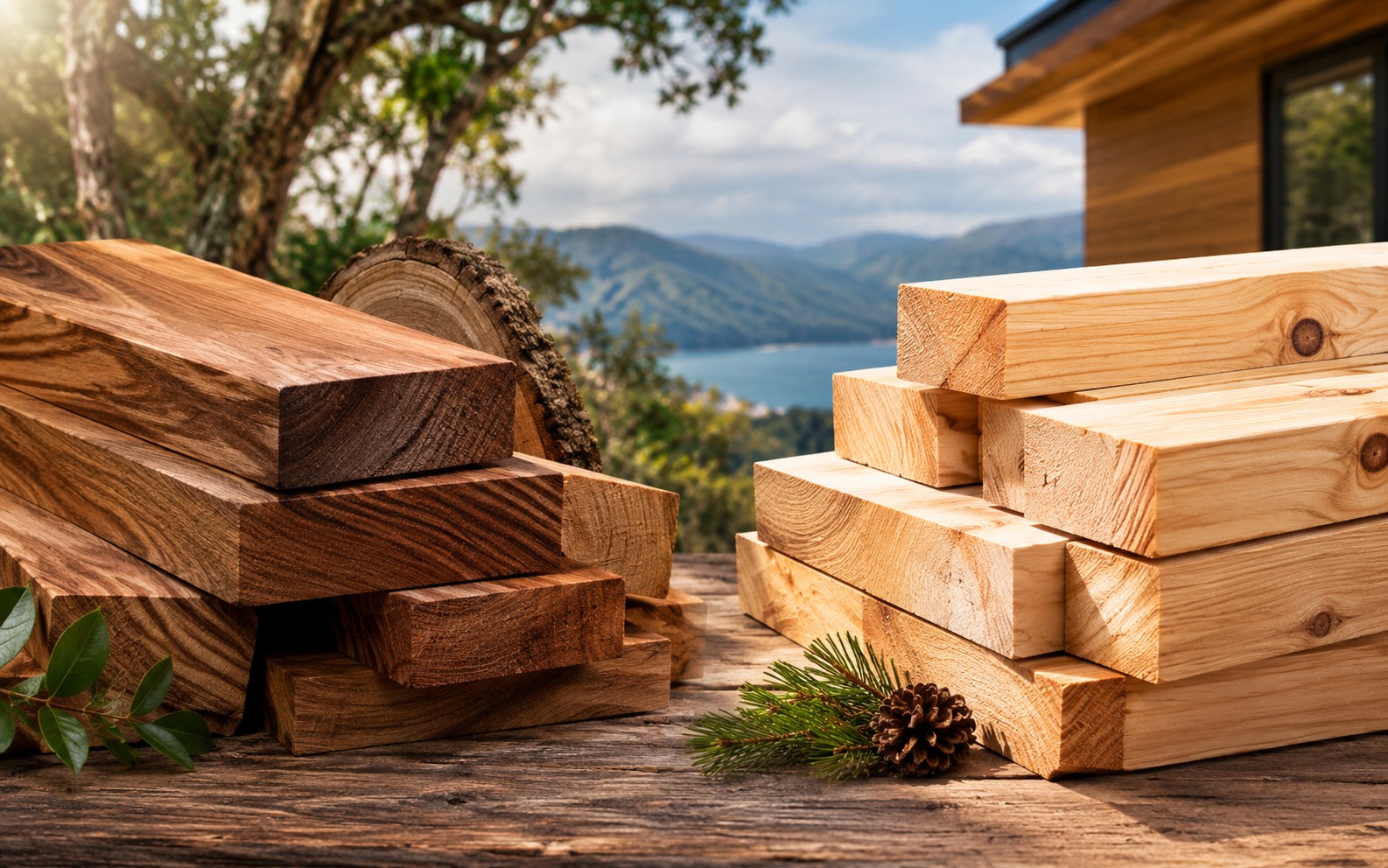
When planning a residential build, structural renovation, or outdoor decking project, one of the most fundamental decisions you will make is selecting the right type of wood. Among the wide range of structural timber and decorative building supplies available today, timber generally falls into two core categories: hardwood timber and softwood timber.
While the terms sound self-explanatory, the true distinction between hardwood and softwood has very little to do with physical density or scratch resistance. Instead, it comes down to botanical biology, cellular structure, growth rate, and performance under specific environmental conditions.
Knowing the main distinctions between these two timber families will help you choose the best material for your building project, whether you’re searching for heavy-duty structural hardwood, premium hardwood decking, or reasonably priced treated pine timber.
What Is the Botanical Difference Between Hardwood and Softwood?
The primary distinction between hardwood and softwood is rooted in seed reproduction and plant anatomy rather than physical hardness.
Hardwood Timber (Angiosperms)
Hardwood timber comes from broad-leaved angiosperm trees. These trees reproduce by producing seeds enclosed within an outer shell, fruit, or flower (such as nuts or acorns). Hardwoods are typically deciduous in temperate regions, dropping their leaves annually, though many native Australian hardwood species (like Eucalyptus) are evergreen.
Hardwoods have specialised cells called vessels (or pores) that effectively move minerals and water throughout the tree at the microscopic level. The complex, tightly packed cellular network that these pores produce is what gives hardwood its distinctive density, strength, and complex grain patterns.
Softwood Timber (Gymnosperms)
Coniferous gymnosperm trees are the source of softwood timber. Gymnosperm means naked seed, which means that these trees reproduce by exposed seeds that are typically found in cones. Softwoods are year-round evergreens with leaves that resemble needles or scales.
Softwoods do not have microscopic vessel pores. Instead, they use tracheids. Tracheid’s are simpler tubular cells that conduct fluids and provide vertical support . Because of their streamlined structure and quicker growth cycle, softwoods are lighter and have a lower physical density than most hardwoods..
Is Hardwood Always Harder Than Softwood?
One of the most persistent myths in construction is that all hardwoods are physically hard and all softwoods are soft. While this rule holds true in most practical situations, there are notable scientific exceptions:
- Balsa Wood: Botanically classified as a hardwood due to its broad leaves and seeds, Balsa is one of the softest, lightest timbers in existence.
- Yew: A gymnosperm softwood that is physically much denser and harder than many broad-leaf hardwoods.
In Australia, physical density is measured using the Janka hardness rating (expressed in kilonewtons, kN). This test measures the force required to embed an 11.28mm steel ball halfway into the wood sample:
- Radiata Pine (Softwood): ~3.3 kN (Soft, easily indented)
- Oregon / Douglas Fir (Softwood): ~4.8 kN (Moderate softwood density)
- Spotted Gum (Hardwood): ~11.0 kN (Extremely dense and tough)
- Red Ironbark (Hardwood): ~14.0 kN (Exceptional indentation resistance)
Key Differences: Hardwood vs Softwood Timber
Here is a quick comparison of hardwood and softwood based on important performance metrics:
- Cellular Structure: Softwoods depend on non-porous tracheid cells, whereas hardwoods have porous vessel elements.
- Growth Rate: In commercial plantations, softwoods mature quickly (usually 15 to 30 years), while hardwoods develop slowly over decades.
- Density and Weight: Softwoods are lighter and more manageable on the job site, whereas hardwoods offer high density and hefty weight.
- Workability: Softwoods cut, nail, and screw readily, but hardwoods require pre-drilling and sharp carbide tools.
- Durability Rating: Unless chemically treated, native Australian hardwoods typically have natural Class 1 or Class 2 durability, while softwoods often have Class 3 or Class 4 durability.
- Fire Resistance: While softwoods need chemical flame retardants to reach higher bushfire ratings, key Australian hardwoods natively fulfill BAL-29 timber classifications.
- Price Point: Softwood is very affordable for large-scale framing, whereas hardwood fetches a premium price because of its slow growth and endurance.
Popular Australian Timber Species
In addition to sustainably managed softwood plantations, Australia is home to some of the best native hardwoods in the world. Structural success is ensured by knowing which species is appropriate for your application.
Common Australian Hardwood Species
- Corymbia maculata, or spotted gum, is renowned for its fiddleback grain, remarkable visual diversity, and Class 1 durability. Perfect for architectural posts, interior flooring, and hardwood decking.
- Eucalyptus pilularis, or blackbutt, is a well-liked golden-brown wood with straight grain and strong fire resistance. Outstanding for structural framing, flooring, and cladding.
- One of Australia’s densest woods, ironbark (Eucalyptus crebra) has deep crimson hues. Frequently used for high-impact commercial floors, bridge construction, and heavy engineering.
- Eucalyptus marginata, or jarrah, is prized for its deep crimson colours and inherent termite resistance. Ideal for highlight joinery and high-end outdoor living areas.
Common Softwood Species in Australia
- Radiata Pine (Pinus radiata): The backbone of Australian residential house framing. Easily pressure-treated (H3 timber treatment and H4) for outdoor structural use.
- Slash Pine (Pinus elliottii): Widely grown in Queensland and Northern NSW for structural framing, plywood, and paneling.
- Oregon / Douglas Fir (Pseudotsuga menziesii): Imported or locally sourced softwood known for exceptional strength-to-weight ratio and straight grain, often used for exposed roof beams and trusses.
Practical Uses of Hardwood vs Softwood Timber
Choosing between hardwood and softwood depends heavily on whether your project is structural, decorative, internal, or exposed to harsh weather conditions.
Uses of Hardwood Timber
- Outdoor Hardwood Decking & Boardwalks: Exposed decks require maximum protection against continuous UV exposure, heavy rain, and constant foot traffic. Hardwood decking made from species like Spotted Gum or Merbau resists cupping, scratching, and warping over decades.
- High-Traffic Interior Flooring: Pets, furniture movement, and heels all cause significant damage on interior wood flooring. Long-term resistance to surface denting is ensured by Australian hardwoods with high Janka hardness ratings.
- Heavy Structural Posts & Beams: Load-bearing posts, bridges, and exposed architectural beams require high bending strength and Class 1 durability ratings that only dense structural hardwoods provide.
- Bushfire-Prone Exteriors: Properties built in designated bushfire zones often mandate naturally fire-retardant building materials. Species like Blackbutt and Silvertop Ash naturally satisfy BAL-29 building codes.
Uses of Softwood Timber
- Residential Wall & Roof Framing: House frames, wall studs, and roof trusses rely almost entirely on softwoods like Radiata Pine (such as MGP10 structural timber). Softwoods are light, easy to handle, fast to nail, and highly cost-effective for large builds.
- Sub-Floor Bearers & Joists: When protected from direct weather or treated with appropriate preservers, softwood joists provide an economical, resilient foundation system under internal floorboards.
- Internal Trims, Skirting & Architraves: Softwood moldings are smooth, exceptionally easy to cut, sand, and paint, making them the preferred choice for detailed indoor trim work.
- Budget Outdoor Structures (Treated Pine): For budget-conscious outdoor builds—such as retaining walls, garden pergolas, and boundary fencing—pressure-treated H3 timber treatment and H4 softwoods deliver excellent resistance to fungal rot and termites at a lower upfront cost.
Environmental Sustainability and Maintenance
When derived from responsibly managed forests certified by PEFC or FSC, both hardwood and softwood are essential components of sustainable construction:
- Carbon Storage: Both timber types store captured atmospheric carbon for the duration of their service life, making timber a far greener choice than steel or concrete.
- Replenishment Rate: Softwood plantations are an ultra-renewable resource for high-volume building supplies because they can be quickly harvested and replaced. Although hardwood forests take longer to reach maturity, they can produce structures that, with proper care, survive up to 50 to 100 years.
- Maintenance Needs: Outdoor hardwood require regular applications of quality decking oils every 12 to 18 months to preserve color and prevent checking. Softwoods used outdoors must remain sealed to prevent internal moisture rot.
Which is better for outdoor decking: hardwood or softwood?
Because of its high density, exceptional wear resistance, and inherent resistance to rot and weather, hardwood is the best material for long-term outdoor decking. Hardwood decking outlasts softwood by decades when properly maintained, despite the fact that treated softwood decking is less expensive initially.
Can softwood timber be used outdoors?
Yes, but only if it has undergone appropriate chemical preservative treatment (such as H3 treatment for above-ground outdoor use or H4 treatment for ground contact). Untreated softwood will rot rapidly when exposed to rain and soil moisture.
Is hardwood timber significantly more expensive than softwood?
Yes. Hardwood is harder to find and more expensive to harvest and treat since it grows far more slowly than softwood. Over time, however, the longer lifespan, structural strength, and low replacement frequency of hardwood make up for the greater initial material cost.
How do I know if my building site requires BAL-rated hardwood timber?
If your property is located in an area designated under Australian Standard AS 3959 (Construction of buildings in bushfire-prone areas), your council or building certifier will assign a Bushfire Attack Level (BAL). Bushfire-prone sites often require naturally fire-resistant hardwoods for external decks, posts, and cladding.
Does softwood timber attract termites more easily than hardwood?
Termites are drawn to untreated softwood because it typically lacks the protective natural extractives and dense cellular matrix of Class 1 hardwoods. On the other hand, contemporary pressure-treated softwoods, like as H2 frame pine, have chemical barriers that effectively prevent termite infestation.
